
What is queer art
Queer art is creation born from the experiences, bodies and perspectives of LGBTQ+ people — art that often questions the norms about gender and desire that culture takes for granted. It is not a style or a technique: it is a position to create from. This guide explains where the term comes from, what defines it and what the queer scene in Spain looks like.
From protest to the museum: a brief history
For decades, queer was a slur. From the 1980s and 1990s onwards, activists and artists reclaimed it as a banner: naming what the norm rejected and turning it into identity and creative language. Art made by LGBTQ+ people has always existed — often encoded, hidden or read between the lines — but queer art as a self-aware category was born tied to activism.
Two moments shaped it. First, the LGBTQ+ rights uprisings of the 1970s, which brought an aesthetics of pride and disobedience out into the street. Then the AIDS crisis of the 1980s and 1990s: faced with institutional silence, collectives of artists and activists turned posters, performance and public imagery into tools of protest and mourning. Much of the visual vocabulary queer art still uses today came out of that urgency.
In the 1990s, queer theory — with authors such as Judith Butler — gave an intellectual frame to what art was already practising: gender as something performed and represented, not a biological destiny. Since the 2000s queer art has entered museums, biennials and fairs around the world without losing its critical edge: it keeps asking who decides which bodies and which desires deserve to be represented.
What defines queer art
- Identity and the body as material. The body — desired, dissident, transformed — is at once subject, medium and argument.
- Archive and memory. Recovering erased histories: loves that could not be named, references kept hidden, whole communities left out of the official story.
- Parody and camp. Humour, excess and artifice as critical strategy: laughing at the norm is a way of disarming it.
- The collective. Against the myth of the individual genius, queer art tends to be made in community: collectives, self-run spaces, parties, radio stations and magazines.
- Visibility as a political act. Showing what was ordered to stay hidden turns the exhibition itself — the venue, the station, the cover — into part of the work.
The queer scene in Spain
Spain has a queer genealogy of its own. In Transition-era Barcelona, Ocaña turned a walk down the Ramblas into gender performance decades before there was a word for it; in 1980s Madrid, the movida — with artists such as Costus — mixed popular culture, sexual dissidence and art without asking permission. That inheritance lives on in today’s scene of independent fairs, municipal venues, collectives and festivals that make room for LGBTQ+ creation.
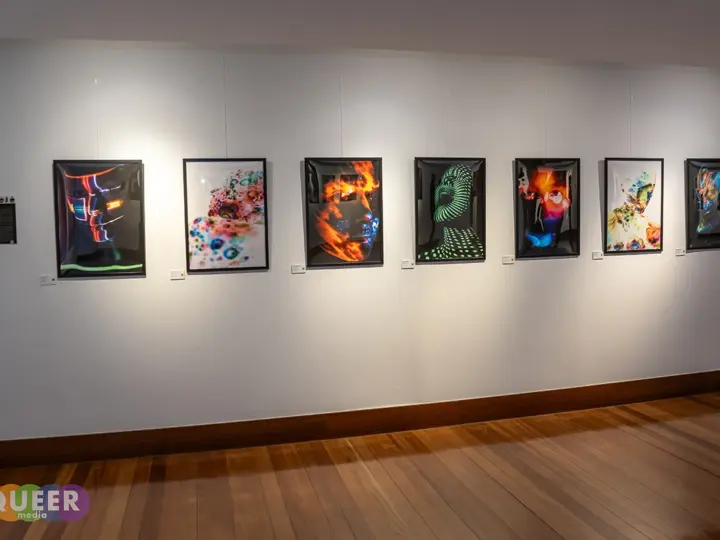
From Madrid, QUEER MEDIA works exactly along those lines: our project Queer Art organises in-person exhibitions — such as QUEER ART MADRID at the Maruja Mallo Hall, with more than 5,000 visitors — and an online gallery where work is sold and the artist gets paid. And Radio Queer Uno streams queer electronic music 24 hours a day. All of it with open calls for emerging artists.
Where to see (and buy) queer art
- The online gallery at queerart.es, with works for sale by queer artists.
- Our exhibitions in Madrid and appearances at fairs such as Hybrid Art Fair.
- The open calls, if you are an artist and want to exhibit.
- The news section, where every new show is announced.
If you want queer art to keep having spaces to be seen and sold, you can partner with us as a company or make a donation: every contribution pays for venues, broadcasts and open calls.
Frequently asked questions
Are queer art and LGBT art the same thing?
They overlap, but they are not identical. “LGBT art” usually means work made by people from the community or about the community. “Queer” adds a critical attitude: questioning the very categories of gender and desire — including within the community itself.
Can a non-LGBTQ+ person make queer art?
It is an open debate. The label is usually reserved for creation born of queer experience; an ally can engage queer themes with respect, but the voice and the space should remain the community’s.
Where do I start as a queer artist?
Check our open calls: taking part is free, the work remains yours and we support you through production, communication and sales.